A company founded in the year of independence
Kanhaiya Lal Garg incorporated The Industrial Gases Limited at Calcutta on 25 July 1947 — three weeks before the British left India. The country had almost no capacity of its own to make the gases that heavy industry runs on. He set out to build it.
Oxygen for steelmaking and for hospitals. Acetylene for every workshop that had to cut or join metal. Unglamorous products, and no country industrialises without them.
He did not only sell the gas — he built the plants that make it
Under his direction the company manufactured its own means of production: acetylene generators, oxygen plants, purification and drying systems, flashback arrestors, and welding and cutting equipment. Carbide-to-water generation, gas purification, pressure regulation, industrial safety — the engineering the business still trades on was settled in his period.
That work put the company in the room where the rules were written. From at least 1970 it sat on the Bureau of Indian Standards committees governing gas cylinders and industrial gases, alongside Praxair India, BOC India, BHEL and ISRO.
Madras, Moscow and the electricity of a new republic
India in the 1960s needed generating capacity faster than it could build it, and much of the plant came from the Soviet Union. The Industrial Gases Limited held the Indian agency for V/O Machinoexport of Moscow, and K. L. Garg negotiated on that account at the highest level.
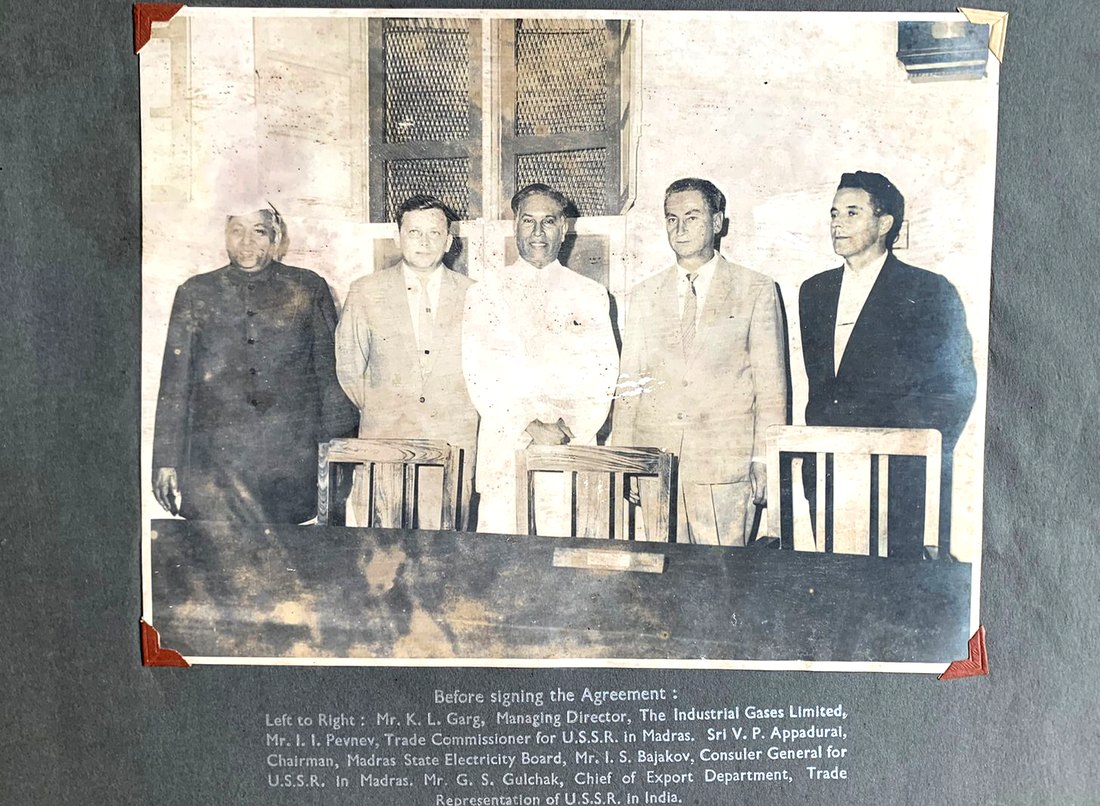
He signed with the Madras State Electricity Board alongside the Soviet trade delegation, and met N. S. Patolichev, Minister of Foreign Trade of the U.S.S.R. Among the projects at issue was the Mettur tunnel scheme, whose stations were commissioned in 1965 on Soviet turbines. The photographs further down are from the company album.
Achievements
- 1947Founded The Industrial Gases Limited
Incorporated at Calcutta on 25 July 1947 to make industrial and medical oxygen and acetylene, and soon afterwards the plant to produce them.
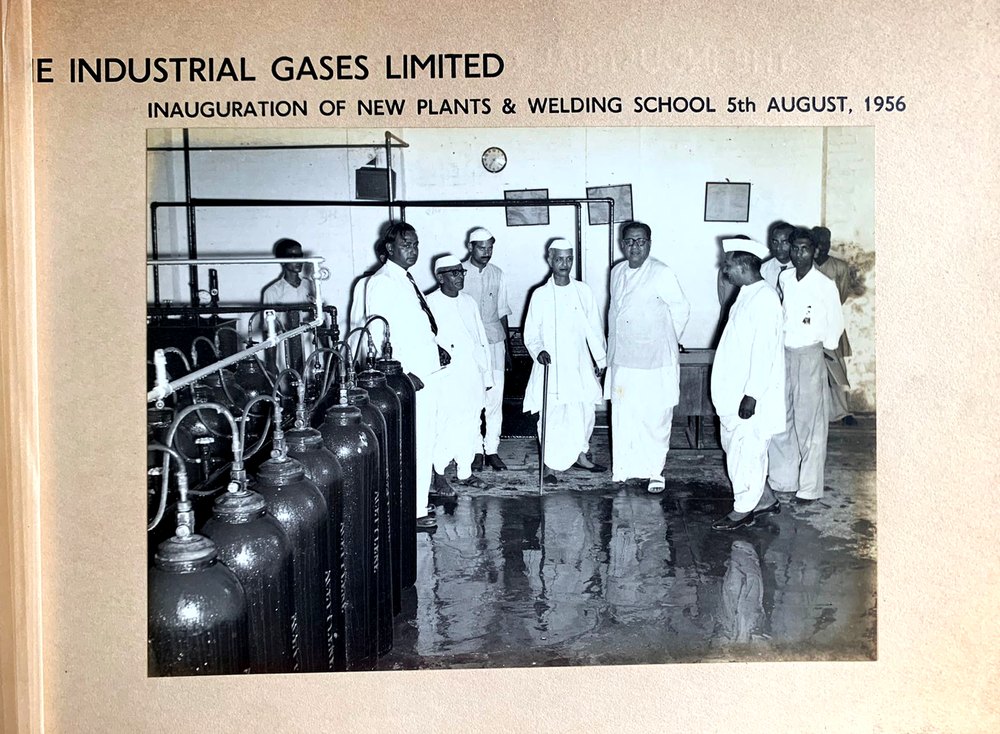
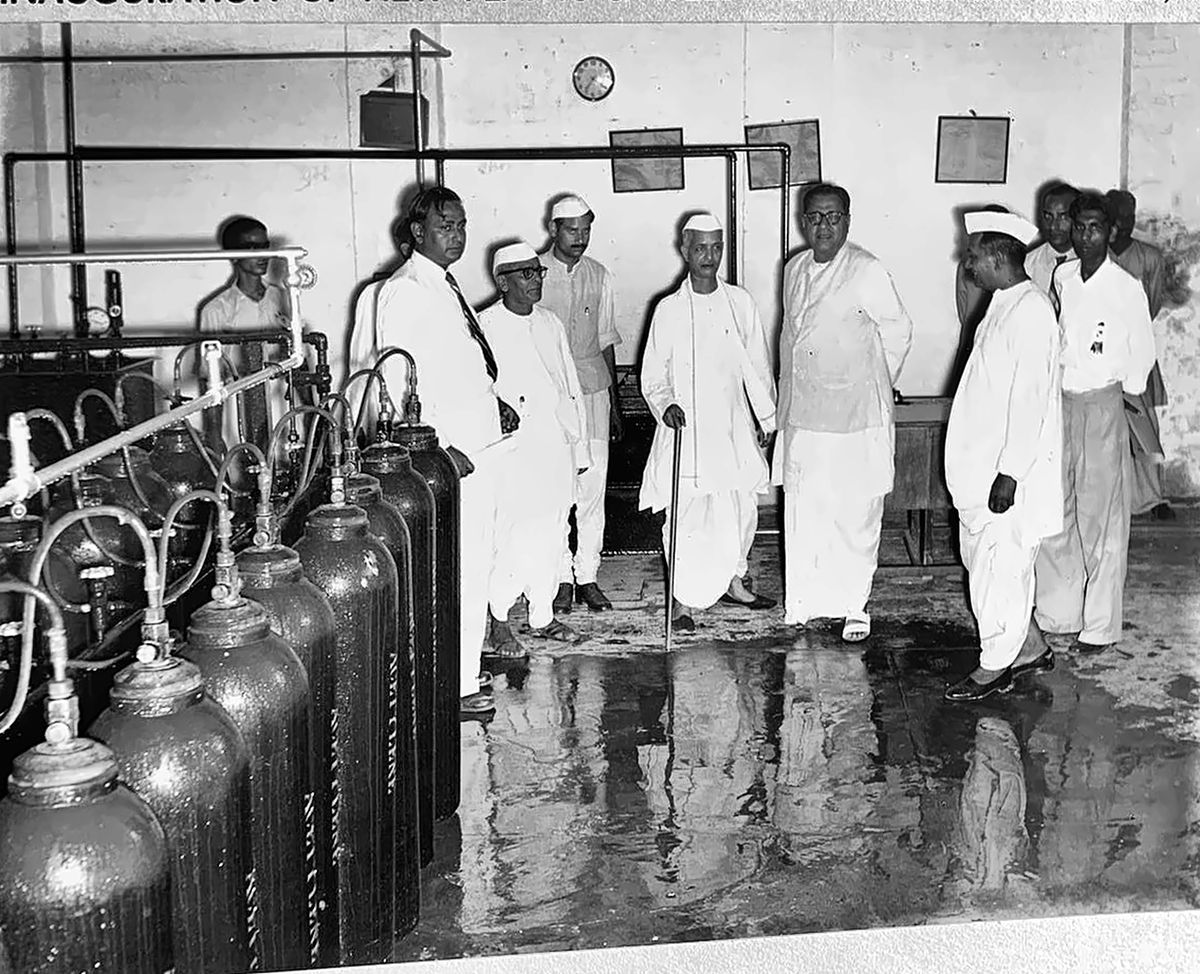
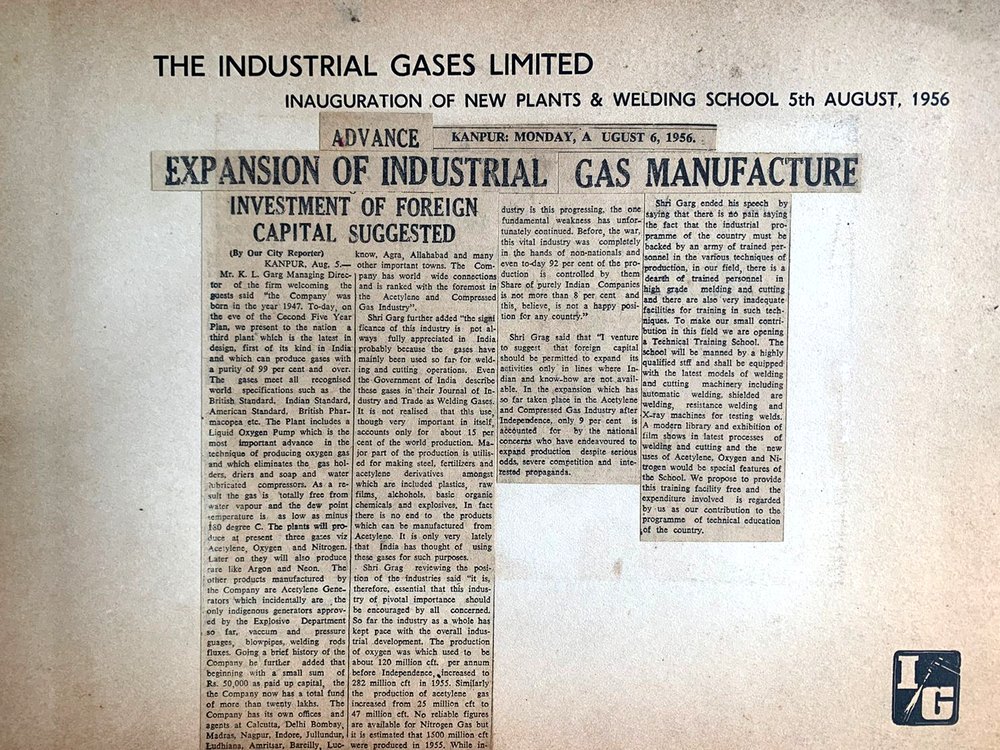
- 1956Opened new plants and a Welding School at Kanpur
At 40 Fazalgunj Factory Area on 5 August 1956. The school taught welding when the trade was short of people who could do it. Saila Kumar Mukherjee, Speaker of the West Bengal Legislative Assembly, performed the opening; Atmaram Govind Kher, Speaker of the U.P. Legislative Assembly, presided; and the chief guest was Chandra Bhanu Gupta, later Chief Minister of Uttar Pradesh.
- 1960A gas plant inside the Guwahati Refinery
A lease of roughly 1.5 acres at Indian Oil’s refinery at Noonmati, Assam, dated 4 April 1960 — the beginning of a supply relationship that has outlasted every party to it.
- 1962–67Negotiated Soviet power equipment for India
Holding the Indian agency for V/O Machinoexport of Moscow, he signed with the Madras State Electricity Board alongside the Soviet trade delegation and met the U.S.S.R. Minister of Foreign Trade, N. S. Patolichev. The Mettur tunnel scheme at issue was commissioned in 1965 on Soviet turbines.
- 1965Oxygen and acetylene for the Diesel Locomotive Works
An agreement of 21 April 1965 put a gas plant inside Indian Railways’ locomotive works at Varanasi, with a minimum offtake of 18,000 m³ of oxygen and 2,500 m³ of acetylene every month. The contract was still being argued half a century later, and was upheld by the Supreme Court of India in 2017.
- 1970–2005On the committees that write India’s gas standards
The Industrial Gases Ltd is named in Bureau of Indian Standards committee records from IS 5903:1970 through to IS 15583:2005, sitting with Praxair India, BOC India, BHEL, ISRO and the Chief Controller of Explosives.
- WorldwideForty foreign agencies
Air Products (Great Britain), Lincoln Electric, Chance Bros of Birmingham, and houses across Sweden, Germany, Austria, Italy, the United States and the U.S.S.R. Memberships ran to the Institute of Welding in London and the Compressed Gas Association of New York.
- TodayFour generations on
The business continues as International Industrial Gases Ltd (IIGAS) and The Kamrup Industrial Gases Ltd, run today by the fourth generation of his family.
The documented record
The company he founded appears in the judgments of the Supreme Court of India, in Bureau of Indian Standards committee records, and on the corporate register. Every source below can be opened and checked.
The Diesel Locomotive Works agreement of 21 April 1965 — a plant inside Indian Railways’ Varanasi complex, with a minimum monthly offtake of 18,000 m³ of oxygen and 2,500 m³ of acetylene — is set out in the Supreme Court of India’s judgment of 11 April 2017.
Supreme Court of India, Civil Appeal 4249/2007 ↗The lease of about 1.5 acres at the Indian Oil Corporation’s Guwahati Refinery, Noonmati, Assam, dated 4 April 1960, is recorded in the Gauhati High Court’s judgment of 6 January 2025.
Gauhati High Court, FAO 89/2024 ↗The Industrial Gases Ltd sat on Bureau of Indian Standards sectional committees for gas cylinders and industrial gases from at least 1970 to 2005 — including IS 8775:1978, where the company’s representative is named.
BIS IS 8775:1978 ↗In IS 15583:2005 the company is listed on the Industrial Gases Sectional Committee CHD 6 alongside Praxair India, BOC India, BHEL, ISRO and the Chief Controller of Explosives.
BIS IS 15583:2005 ↗The successor companies remain on the corporate register: International Industrial Gases Ltd (incorporated 6 January 1976) and The Kamrup Industrial Gases Ltd (incorporated 10 May 1984), both at 146 Andul Road, Shibpur, Howrah.
Ministry of Corporate Affairs registry ↗
The founder’s era, in pictures
Restored from the original company album. K. L. Garg is the figure in the white Gandhi cap and dark bandhgala.